


How to Run Your Creative Business Without Losing Inspiration
Creative professionals, designers, writers, makers, photographers, and other independent artists often discover that the hardest part of the work isn’t the craft; it’s the creative-business balance.
Between artist financial management, admin tasks, and the uncertainty of inconsistent projects, managing a creative business can start to feel like a second job that steals energy from the art.
These creative entrepreneur challenges are common and rarely a sign of failure; they’re a sign that the business side needs clearer structure. With a few steady fundamentals in place, the business can feel manageable, and the creative work can stay in focus.
Quick Summary: Confident Creative Business Basics
- Price your work clearly so clients understand value, and you protect your time.
- Use simple contracts to set expectations and reduce misunderstandings.
- Send straightforward invoices to get paid smoothly and on time.
- Follow a lightweight creative workflow to manage projects with less stress.
- Organize your finances and market authentically to build steady, sustainable momentum.
Create On-Brand Promo Images in Minutes With Text-to-Image AI
Once you’ve got the essentials mapped out, your marketing visuals can be one of the quickest wins for staying visible without draining your energy. AI-generated images make it easier to create engaging promo content that matches your brand look and feel, so your posts, banners, and announcements stay polished even when you’re short on time.
With a text-to-image tool like Adobe Firefly, you can type a prompt and generate fresh, brand-friendly visuals in minutes, streamlining the process of creating visual content to promote your brand. Next, we’ll shift from promotion to the core systems that keep your business running smoothly: pricing, paperwork, workflow, and money.
Set Up Simple Systems for Pricing to Taxes
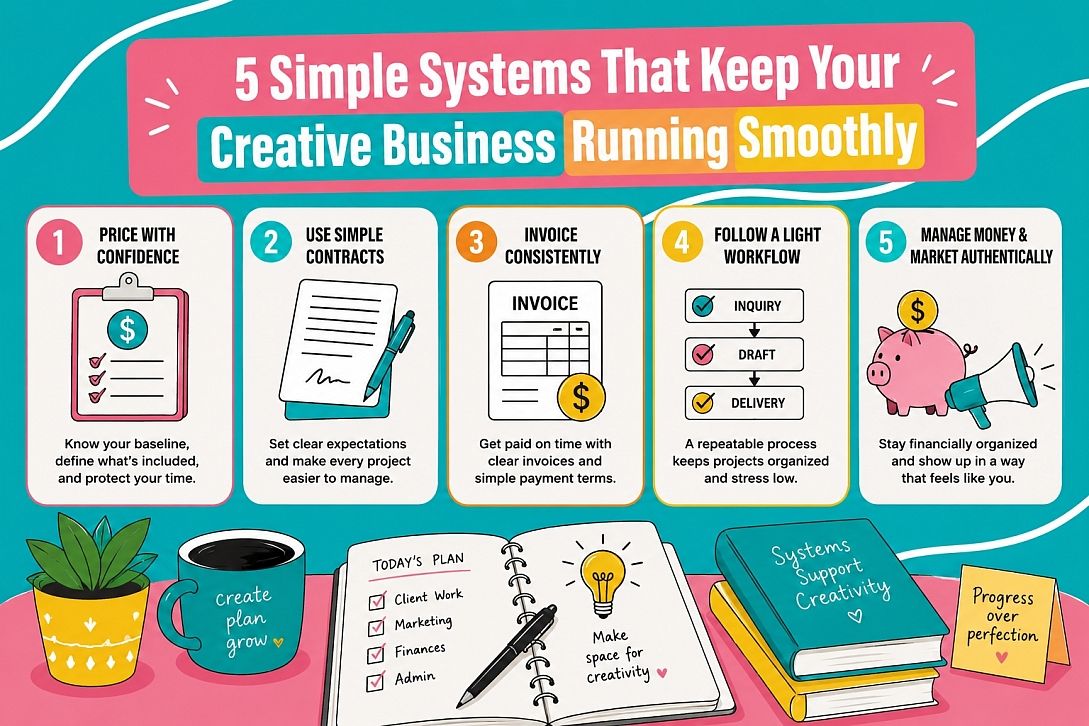
These are the core systems that turn creative work into a steady, low-stress business. When pricing, paperwork, workflow, and finances are repeatable, you spend less time scrambling and more time creating.
- Set a pricing baseline you can repeat.
Start with one clear “minimum project price” or “day rate” that covers your time, tools, and a cushion for admin work. Write down what’s included, what costs extra, and a simple revision limit so you are not renegotiating on every inquiry. Keep it simple enough that you can quote confidently in a message. - Choose one contract and one invoice routine.
Pick a short contract template you can reuse for most projects, then standardize three terms: scope, timeline, and payment schedule. Pair it with one invoicing habit, such as invoicing immediately after signing and again at milestones, so clients always know what to pay and when. Save both in a single folder so you can send them within minutes. - Map your workflow from inquiry to delivery.
Create a one-page checklist that follows the same path every time: inquiry, discovery call, quote, contract, deposit, kickoff, drafts, revisions, final files, closeout. Assign one “next action” for each stage, plus where files live, so you do not lose track mid-project. This becomes your calm default when you are busy. - Start financial tracking with two weekly habits.
Separate business income and expenses in one place, then log transactions once a week for 15 minutes. Keep a simple “money in, money out” snapshot and store receipts as you go, especially for online sales and payments, where 1099-K forms may show up later. - Prep for taxes with a monthly mini-checklist
On one day each month, update your income totals, confirm your expense categories, and save the documents you will need at filing time. Make it routine to gather key personal details and other essentials in a single folder so tax season feels like assembly, not a scavenger hunt.
Weekly Habits for Calm, Confident Creative Work
Habits are what keep your systems alive when your schedule gets full. A small set of repeatable practices helps you market consistently, communicate clearly, and protect creative energy without overthinking every decision.
Two-Sentence Client Update
- What it is: Send a brief progress note with next steps and one question.
- How often: Weekly during active projects.
- Why it helps: The uplift in revenue tied to better communication reinforces this simple habit.
Scope Boundary Reminder
- What it is: Restate the scope statement boundary before you start drafts or revisions.
- How often: At kickoff and before each revision round.
- Why it helps: It prevents quiet add-ons that steal time and confidence.
Deposit First, Then Start
- What it is: Begin work only after the deposit is paid and confirmed.
- How often: Per new project.
- Why it helps: It reduces financial anxiety and sets a professional tone.
Marketing Proof-of-Work Post
- What it is: Share one small lesson, process photo, or before-and-after from recent work.
- How often:
- Why it helps: It attracts aligned clients without aggressive selling.
Admin Shutdown List
- What it is: End the day by writing tomorrow’s top three business actions.
- How often:
- Why it helps: It clears mental clutter so you rest and create better.
Scale Your Creative Business with Simple Systems That Hold
When client work grows, it’s easy for marketing, communication, and boundaries to slip into chaos that drains your energy. The steady approach is to keep your business system routines simple: choose a few foundational tools for creatives, protect consistent rhythms, and adjust them as your creative career growth changes your needs.
That’s how scaling a creative business starts to feel calm: fewer fires, clearer decisions, and more room to make strong work. Pick three tools, review them monthly, and let your systems grow with your creativity. For the next step, you can schedule a monthly business review and decide what to keep, streamline, or retire. This matters because sustainable systems protect your health, your focus, and your long-term stability.
Recent Posts






0.0891